The Future
12 Sessions, 7 September - 23 November 2027
Tuesdays
6pm - 8pm
About
Philosophy has often had an uneasy relation to the future. From Plato onward, it has tended to distinguish rational thought from prophecy, divination and speculation about what has not yet happened. Philosophy sought truth in what is, while the future appeared too uncertain and contingent to become a proper object of knowledge.
Yet the future returns wherever philosophy confronts possibility, history, responsibility and change. Modernity transformed it into a promise: societies could progress, humanity could transform itself, and history could move towards something genuinely different. Today that confidence has weakened by technological accelerations, ecological crises and political uncertainty, which have made the future at once urgent and difficult to imagine.
This course asks what it means to think philosophically about what does not yet exist. We begin with Plato and the exclusion of futurity from philosophical knowledge, before turning to Marx, for whom capitalism produces a distinctive experience of time organised around accumulation, expansion and the anticipation of future value. Nietzsche asks a different question: what kind of human being is capable of having a future? Rather than securing ourselves against uncertainty, might having a future require the capacity to expose ourselves to what cannot be predicted?
With Hans Jonas, futurity becomes part of the structure of life. A living being acts through need, anticipation and possibilities that have not yet been realised. Its future is neither predetermined nor completely open: possible futures already exert a force on how it behaves now. This becomes especially important once technological power makes human action capable of transforming the conditions of life for generations that do not yet exist.
Bruno Latour approaches the future through a critique of modernity, understood as a system of separations: nature from society, science from politics, human actors from non-human ones. Modernity also organised time around a contrast between an obsolete past and a progressive future. Yet for Latour, these divisions never truly held. Scientific discoveries, technologies, institutions, organisms and environments have always formed hybrid networks in which nature and society are entangled. The ecological crisis makes this impossible to ignore - the future can no longer be imagined simply as progress away from the past. The question becomes less "where is history taking us?" than "with whom, and with what, can we continue to live?".
Throughout the course, we will distinguish the future from prediction. Prediction extends existing tendencies forward, whereas futurity raises the possibility that what comes next may not resemble what came before. The philosophical problem of the future is therefore also the problem of novelty: how can something genuinely new enter the world?
While algorithms claim to predict behaviour, markets organise the present around future expectations, and technological and ecological models determine decisions about worlds that do not yet exist, philosophy aspires to think the future without turning it into prophecy or a projection of the present. Can we learn to inhabit a future whose defining characteristic may be precisely that we do not yet know what it can become?
What will we cover?
-
Whether the future can be thought philosophically without reducing it to prediction or the continuation of the present.
-
How modern ideas of progress, capitalism, technology, and responsibility have shaped our relation to what is yet to come.
-
What it means to inhabit an open future in which human and non-human forms of life, ecological systems, and technologies must be thought together.
Requirements
This course is open to anyone interested in exploring the future from a philosophical perspective, and assumes no prior knowledge.
Teacher
Dr. Daniel Weizman
Price
£330
Location
Fitzrovia, London
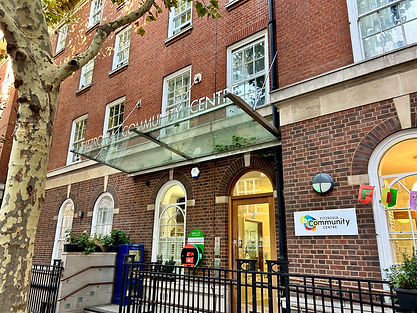
We are located at Fitzrovia Community Centre,
2 Foley Street, London W1W 6DL
Our classes take place in a modern meeting room, just a short walk from Goodge Street and Oxford Circus Underground stations.
The location is fully accessible, with step-free access and facilities to accommodate all mobility needs.